Total Pageviews

Saturday, 12 August 2017

Penmon Priory and Lighthouse

So, after the boat trip to Puffin Island, was there cake? Was there even a cup of tea? No. Barely had my feet touched dry land, when off we went again, through narrow one track lanes towards Penmon- Penmon Priory to be exact. I'd had a taster of it prior to the boat trip, but we decided it would be better to do the boat trip first, seeing as we were pressed for time and the priory didn't shut as such (though, for your reference, should you decide on a visit, the church is locked at 6pm, earlier if there are no cars in the car park).
 If you like your historic buildings and you're in the area, make a point of visiting this. There were a few visitors there when we arrived (about 4pm), but it's not busy, and the car-park attendants (who I assume are volunteers) are very chatty and helpful. The car parking is £3, and that includes access to the priory and your toll to go to the light house later. If you need to leave and come back again, tell the attendant and they will note down your car reg. and not charge you again when you return.  
It's a compact site, so ideal for the weary and foot sore, though the less spritely may need some assistance here and there.
 Most of the buildings here date from the thirteen century, and were probably built on the site of the original Celtic monastery. Further buildings were added in the sixteenth century.
 The original settlement was founded by St Seiriol in the sixth century and St Seiriol's Holy Well can still be accessed through one end of the car park.
 The priory was occupied by Augustinian monks until the Dissolution of the Monasteries in the sixteenth century, when it was handed over to the Bulkeley family, who were responsible for the wonderful dovecote.

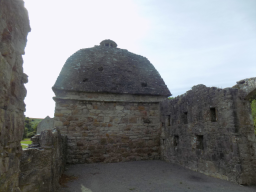


 Don't forget to visit the church in the complex, as well, which is also very interesting, boasting medieval architecture and some nice stained glass windows. If you want to have a look at what you might be missing, hop over to my Pinterest page, and see all the pictures relating to this.
 So, having had our fill of this site, we headed over to Penmon Lighthouse. This was another interesting place, but for other reasons.
Besides the lighthouse (which you can get to at low tide), there is a wonderful array of rock pools both deep and shallow, with varying amounts of sea-life trapped in them by the retreating tide. If your little ones have been unimpressed with the priory, they will love this.

  If memory serves me correctly, there is a little refreshment hut nearby and this may just be the thing you need to placate and weary any junior members of the family before the long drive home. So don't forget the shrimping nets. Also look out for fossils- there are some very apparent ones under your feet.
 As for the Trwyn Du Lighthouse, it is still in use, and if you click on the highlighted link, you should find some more information on it

So, all in all, an interesting and relatively cheap day out. I believe our next outing will be to the deepest, darkest interior of North Wales in search of obscure chapels, lost Roman outposts and places not even the postman has heard of.

https://www.pinterest.co.uk/traceymeredith3/

Wednesday, 9 August 2017

Puffin Island from Beaumaris


 We set forth from Beaumaris harbour with Seacoast Safaris, on a catamaran. Just under £10 each for two adults (the P&J was probably still in bed). We had a running comentary on the coastline we were passing- the place where seaplanes used in WW2 were housed, Penmon priory and the lighthouse.


There was an abundance of wildlife at sea, and not just your bog-standard gulls- shearwaters, gannets, cormorants and shags- but, unfortunately, no puffins- the last one left last week, their breeding season now over.
 Once upon a time, we were told, puffins were numerous on the island, making their nests in old rabbit holes (the rabbits having been introduced by a religious community that once occupied the island). Things changed one fateful night, with the paddle steamer, The Rothsay Castle in 1831. It got into serious difficulty, sinking with most of the passengers.
 Among the survivors were rats that made their way to Puffin Island, and prospered at the expense of the local wild life.

The rats have now been eradicated and the puffins are making a come back, arriving in the summer to breed. Currently they nest in crevices, but there are plans to re-introduce rabbits to the island, which beside providing burrows for the puffins, should keep the vegetation in check.
 Other wild life on and around the island- and the ones we all hoped to see- are gray seals. Puffin Island now has its own colony, and they kindly deigned to make an appearance for us.

   Then a quick chug back to Beaumaris for the next part of the day's outing- a visit to Penmon Priory and its local lighthouse.


For the rest of the pictures relating to
 this blog, click here
https://www.pinterest.co.uk/traceymeredith3/puffin-island-from-beaumaris/


Sunday, 6 August 2017

RSPB nature reserve- The Conwy Estuary

We came across the Conwy reserve last year, having picked up the signposts for it while coming through Llandudno Junction. Unfortunately, at that time we arrived just before closing time and so didn't get to see more than a peek of the Conwy Estuary, from the car park.
 You enter the reserve through a wooden cabin which, besides housing the tills, contains a more upmarket selection of souvenirs, as well as a selection of binoculars and such like, wild-life books and leaflets and a good selection of wild bird food. There's also a cafe and toilets here, as well as an area for the kids to have a run around. This first bit is free and consequently quite busy. To get out into the reserve, you have to pay (consider it a donation).
 This is a reserve designed to attract a variety of wild-life, not just birds, as obviously birds are dependent on flowers and insects etc for their existence, and the presence of so many birds, in turn, attracts other wild-life.
 There were a lot of butterflies, including the red burnet, which some people were confusing with the cinnabar moth, which is a similar colour.
 There is a lot to please botanists, as to attract butterflies, a lot of wild plants are being encouraged to grow, including ragwort so beloved of the cinnabar moth, and so disliked by land owners because it's poisonous to horses.
  The reserve is accessed by following a number of sign posted, firm pathways, most of which are suitable for wheel chairs and prams.
 There are hides at the end of most of these pathways, with viewing holes set at different heights, and a stepped stool is available for the vertically challenged to stand on (the site encourages children).
 There is, obviously, walking to be done, though mostly on firm, level ground, and at the end of the day, you can walk as much as you want. Or not, as the case may be.
Typical estuary birds are egret, heron, moorhen, coot, duck and swan, as well as gull, lapwing, godwit and water rail.
 Watch out for the robins. A fair few of them are very tame- though it could have  been the same robin following us around.
 If you look across the estuary, you will see Conwy Castle in all its glory. If you finish early enough at the reserve, go and visit Conwy itself and, if you can afford it, the castle. It's worth the effort.
And let us not forget the mountains on the other side of the river, which make this place so,so special.


Monday, 31 July 2017

The First Big Adventure. And it's scary

So the P&J has just left on his first big solo adventure- cycling from here (Bristol) to Colwyn Bay (North Wales coast). He has a hotel room booked in Shrewsbury for tonight and is carrying a rucksack that weighs a ton(full of food and water, so it will get lighter). He's had a big breakfast, and we will be following to Hereford later today in case he finds he's bitten off more than he can chew.
 He's aiming to cover 103miles today and similar tomorrow. We're the emergency crew this side of Shrewsbury, my brother will take over after Shrewsbury. I've put £60 on his phone, so there's no excuse not to keep in touch. I have explained to him that we will worry, so can he text us when he stops to tell us where he's got to, and particularly when he gets to Hereford. After Hereford, he's got forty-odd miles to do to get to Shrewsbury and his bed for the night. I think if he gets to Shrewsbury, he'll finish the journey, and we'll see him again Thursday night.
So we're trying not to think of what might go wrong and hoping he'll make it to the end. He's been planning this journey for a long time and he'll be greatly disappointed if he doesn't. He's thinking about cycling back, so we might have it all to do again, next week!

UPDATE-Unfortunately, he only got as far as just outside Hereford due to a problem with his back tyre. We tried to fix it outside Halfords in Hereford, but to no avail. We traipsed back home to see if we could sort it out and then drop him at the TravelLodge to resume his journey from Shrewsbury, but we can't fix it (the rim tape is basically rubbish and causing punctures). He's too cheesed off to decide whether he'll have another go, but he will be visiting the bike shop tomorrow to get some decent rim tape. I got some nice photos of Hereford, though (there's always an upside).

 He has learned from the episode and accepts he didn't prepare well enough, didn't start out early enough and he was carrying too much weight in his rucksack. What is probably most galling, though, is that mum and dad were right all along, but he didn't listen. 


Saturday, 29 July 2017

101 Things To Do With an Old Wooden Pallet: Number 2- A modular raised bed

Number 1 was the planter, remember? And as dear Mr Davie has kindly brought  me 4 more pallets of varying sizes, I thought it was time to be creative. Again, I'm trying to do as little DIY as possible, so I'm using what's already there, where I can. Those of you with bigger muscles and hammers will no  doubt be more able and willing to discombobulate a pallet, and create a super design, but mine, well, it works.
This was made from two pallets of different sizes, using a mallet, an old chisel and a saw (to dismantle), a hammer and some nails. It was  then given a coat of wood preservative.
 The bits I used were the "feet" of the pallets, which I sawed free as I couldn't get the nails out of the wood easily. Taking the "feet" and their attached planks of wood means you've already got your module almost made, only requiring one more plank on one side to make an open box. The planks not nailed to the "feet" are a lot easier to get off the pallet and reuse.  
 I left one side open, my thoughts being that I could put companion plants in there (marigolds and herbs, for example) to help control pests. At the moment, I'm thinking that I will place the four sides where I want the raised bed to be, and raise the soil level inside it  with compost. I'm hoping the weight of the compost and plants in the "wall" of the raised bed will keep  things in place, but if that turns out to be impractical, I can't see it being difficult to make the thing more rigid. We'll see next year, won't we?
 I have two pallets left and the bits left over from these pallets. What can we conjure up next? And here's a picture of my young thrush, who was watching what I was doing in to the expectation there'd be food afterwards.

Friday, 28 July 2017

Feed the Birds, Tuppence a Bag


 Well, more like £20.00 actually. You know you're feeding them well when the Mafia and the hoodlums (starlings and magpies) move in.  The above is one of my new best mates in the garden. It nearly did itself an injury trying to find its way out of the greenhouse this afternoon, but did a sterling job clearing up the mess I made when a poorly sited bag of meal-worms fell on the floor this morning, so I tried not to laugh. Frankly, I'm surprised it could still get airborne.
 We've had a lot of new families moving into the neighbourhood this spring, partly thanks to the overgrownedness (it's a word I've just made up) of my neighbour's garden, which has provided a lot of secure nesting sites, and my lack of a cat to threaten them all. I'm trying to build up a bird community to help me with the pests when (I hope) my organic garden gets into full swing next year. I'm not quite sure what use the magpies and their kin are going to be, though, other than providing the entertainment. I just witnessed a magpie trying to jump up onto the apple tree trunk, completely misjudging it and almost knocking itself unconscious. It tried to look like it meant to do it and wandered dazedly under the garden table. I'm assuming it's a youngster and hasn't quite mastered its wings yet. It's either that or some of the apples lying around the garden are fermenting. That being the case, I look forward to the spectacle of some raucous parties among my corvine acquaintances as the summer draws to a close.


Monday, 10 July 2017

To Jemara the Cat. We Will Miss Her Sorely


It is with great sadness and with broken heart that I have to tell you Jemara, vanquisher of the neighbourhood rats, is no more. After a short illness that has progressed rapidly in these last few days, it was decided by ourselves with the help of our vets at Watkins and Tasker, that her suffering had greatly increased, was irreversible and the kindest thing was for us to help her on her way.
 She died in my arms at 10 o'clock this morning, still purring 'til her last breath. Neither I or my husband have stopped crying yet and the pain of losing such a wonderful animal will be with us for some time. We have laid her to rest under the yew tree, her favourite spot, where she can watch the birds gathering on the lawn forever.
 If there is an afterlife, no doubt her previous owners, Shelagh and Jeff, and her dog-brother Nubi (who we also looked after) will be waiting to greet her at the gates of the Happy Hunting Grounds.
  Goodbye Jemara. You go before us, in peace and without pain. We will so miss you.